favorite News: movies
Headlines News :

Latest Post

Showing posts with label movies. Show all posts

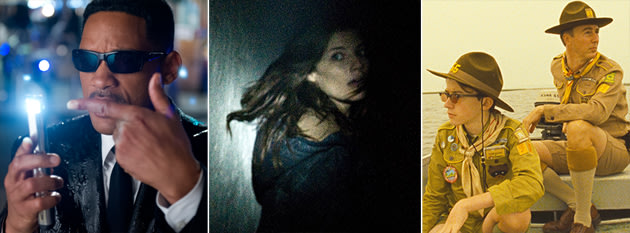
Weekend Picks: ‘Men in Black 3,’ ‘Chernobyl Diaries’ & ‘Moonrise Kingdom’

Written By Unknown on Friday, May 25, 2012 | 11:36 PM

(Photo: Columbia Pictures/Warner Bros. Pictures/Focus Features)
Industry insiders are saying "Men in Black 3" will push "Marvel's The Avengers" out of the winnner's circle this Memorial Day weekend to claim No. 1 at the U.S. box office.
Since it appears everyone on the planet has seen "The Avengers" at least once, I agree the MIB3 bet is a sound one.
Here are highlights of this weekend's new releases:


Men in Black 3

Sony Pictures
Rated PG-13 for intense sequences of violence, action and destruction, and for language.

What's the Story?

Agent J and Agent K are back, but this time with the addition of a young K (played by Josh Brolin, who, by the way, does a dead on impression of Tommy Lee Jones). Monowheel chases and aliens ensue as well as the need to unlock certain kept secrets to the universe to save K and mankind.

Who Will Dig it?
People who still like to get jiggy with it a/k/a Will Smith fans. Sci-fi and action fans with a sense of humor. Former fans of both (but not at the same time) "Flight of the Conchords" and the Pussycat Dolls should be keen on villains played by Jemaine Clement and Nichole Scherzinger.


Chernobyl Diaries


Warner Bros.
Rated R for violence, some bloody images and pervasive language.

What's the Story?
A group of young and attractive travelers find themselves at the site of the world's most devastating nuclear accident to date -- Chernobyl (in the Ukraine). They become stranded in the deserted city and make the excruciating discovery that they are not alone.

Who Will Dig It?

Horror and suspense fans (think "Paranormal Activity" and "The Blair Witch Project"). People who are too young to remember the real 1986 Chernobyl disaster (because for those of us who do, the premise may seem in poor taste.)


 Moonrise Kingdom

Focus Features
Rated PG-13 for sexual content and smoking.

What's the Story?
According to the buzz at Cannes and early reviews, Wes Anderson is in top form with this release (which will continue to widen in the weeks to come for those of you who are not in L.A. or New York). This film, of course, starring Bill Murray -- along with Edward Norton, Bruce Willis, Tilda Swinton, and, of course, Jason Schwartzman -- takes place at a kids camp circa 1965 where two 12-year-olds fall in love and run away, making their surrounding community frantic for their return.

Who Will Dig It?
Did you like "Rushmore" and "The Royal Tenenbaums"? You'll like "Moonrise."


Leonardo is Great in bed

Written By Unknown on Wednesday, May 23, 2012 | 11:45 PM

The Great Gatsby starring Leonardo DiCaprio and Carey Mulligan
Love story ... Leonardo DiCaprio and Carey Mulligan
LEONARDO DiCaprio beds Carey Mulligan in the first glimpse of The Great Gatsby. 

The new trailer for the movie takes us into the heady world of 1920s New York – the era of flappers, jazz, wild parties and steamy affairs. 

The trailer begins with the words: ‘New York, 1922, the tempo of the city had changed sharply. The buildings were higher, the parties were bigger, the morals were looser and the liquor was cheaper.’
And the first clips of the movie reveal the fabulous costumes, sumptuous sets and stylish look that are the trademarks of director Baz Luhrmann, who was behind Romeo And Juliet and Moulin Rouge. 

Tobey Maguire is narrator Nick, an innocent out-of-towner fascinated by the wealthy lifestyle of his charismatic neighbour, Jay Gatsby – played by Leo. 

After befriending the lad, Jay persuades him to arrange a meeting with his married cousin Daisy (Carey), the love of Gatsby’s life.
Leonardo DiCaprio and Carey Mulligan
Rekindled romance ... Leonardo and Carey
But the couple’s rekindled romance, and the anger of Daisy’s husband Tom (Joel Edgerton) threatens to bring the party to an end.
The Great Gatsby STARRING: Leonardo DiCaprio, Tobey Maguire, Joel Edgerton, Carey Mulligan,
Charismatic ... Leonardo as Gatsby
Based on the bestselling novel by F. Scott Fitzgerald, The Great Gatsby also stars Isla Fisher, as Tom’s mistress Myrtle, and Elizabeth Debecki as Jordan. 

The movie is due for release on Boxing Day.
Carey Mulligan and Tobey Maguire
Flapper ... Carey Mulligan and Tobey Maguire

Pete Doherty enjoys snog in his highly-panned acting debut

Pete Doherty
Passion? ... Pete Doherty snogs on screen
PETE Doherty enjoys a sizzling smooch in the trailer for his debut acting role. 

The 33-year-old British rocker received scathing reviews for his performance as a young romantic in Confession Of A Child Of The Century in Cannes earlier this week. 

It marks his first ever foray onto the big screen, but judging by the reaction it should be his last. 
Pete Doherty
'Bored'? ... Doherty
The promo sees Pete mix up several sex scenes with a generally 'wooden performance'.
He plays a libertine who falls into depression after his mistress (Lily Cole) betrays him.
Pete Doherty
Womanising role ... Pete Doherty
But the frontman's acting skills have taken a bit of a battering in his first role as a philosophising dandy.
Pete Doherty
On the red carpet ... Pete in Cannes earlier this week
Critics have called his appearance a "calamitous miscasting" mixed with "mumbled lines" and a "permanently bored expression".
Lily Cole
At the premiere ... co-star Lily Cole
They have also said he looks "like he'd rather be somewhere else" for much of the film.
Pete Doherty
Doh-dgy ... Pete not at his best
Mark Ronson's wife actress Joséphine de La Baume stars alongside Lily and Charlotte Gainsbourg.
No UK release date has yet been set.

Cannes 2012: Killing Them Softly, review

A still from Brad Pitt's new film Killing Them Softly
Brad Pitt's outstanding new film Killing Them Softly has the rigor and poise of the great American crime pictures of the 1970s, writes Robbie Collin. 

Dir: Andrew Dominik; Starring: Brad Pitt, Ray Liotta, Scoot McNairy, Ben Mendelsohn, James Gandolfini, Richard Jenkins. 104 min.
 
Hollywood has come to Cannes – or has it? Brad Pitt and Kristen Stewart have arrived on the Croisette, and the assembled photographers have flown into the obligatory frenzy. But these hardy red carpet perennials’ new films are directed by two relative industry outsiders: the New Zealand-born Australian, Andrew Dominik, and the Brazilian Walter Salles.
Dominik’s outstanding Killing Them Softly has the rigor and poise of the great American crime pictures of the 1970s. It is a loose adaptation of George V Higgins’ 1974 crime novel Cogan’s Trade, relocated from Boston to New Orleans, 2008, a city bludgeoned by Hurricane Katrina and sucker-punched by the Great Recession. In almost every scene, televisions blare with Obama’s Presidential campaign promises, but the story that unfolds gives the lie to his hopeful rhetoric.
Pitt plays Jackie Cogan, a hired killer paid to clean up the aftermath of a heist on a mob-controlled poker game by two weaselly wannabes on the make (Scoot McNairy and Ben Mendelsohn). His modus operandi is stealth: "I like to kill them softly, at a distance," he explains, although needless to say, things don't pan out entirely in accordance with his wishes. He is assisted by Mickey (James Gandolfini), a monstrous backup assassin who looks as if he should be living under a bridge, eating goats.
Dominik shoots the action in a grimy shallow focus, as if the entire nation is cloaked in a miasma of atomised filth, and his screenplay is tough as beaten steel and shot through with pessimistic, even nihilistic humour: Pitt’s electrifying final speech is worth the price of admission alone. The political and economic context is laid on thick, but in a way that future proofs the film for audiences in ten, 20, even 50 years. This is only Dominik’s third film after Chopper and The Assassination of Jesse James, but it has the lines and contours of a classic.

Chloë Sevigny interview for Hit & Miss on Sky Atlantic

Chloe Sevigny as Mia in Hit & Miss
Chloë Sevigny has always been drawn to edgy roles, but her latest – as a transsexual assassin in Sky Atlantic's new mini-series, Hit & Miss – is her biggest and strangest yet. 

When Chloë Sevigny’s agents called her last year to say they had received a new script for her to consider, they were unusually coy about the details. “They said, ‘It’s really wild. We just think you should read it,’” Sevigny tells me when we meet in London. “So I did, and I was like, ‘This is insane. I have to do it.’”
Weeks later, the 37-year-old American actress was on set in Manchester, quietly weeping and wondering what she’d done, while a make-up artist hovered over her crotch, carefully fitting a prosthetic penis.
Created by Paul Abbott, the Bafta-winning writer behind State of Play and Shameless, Hit & Miss is a new television miniseries with the most extraordinary premise. Sevigny plays Mia, a preoperative male-to-female transsexual who works, with cool efficiency, as a contract killer. She is also, she discovers to her shock, a father: in the opening episode, an ex-girlfriend writes to tell her that they have an 11-year-old son and, since she is terminally ill, she has nominated Mia as guardian of the boy and his three half-siblings.
In summary, this may sound preposterously camp and over the top but, thanks to Abbott’s delicate script and a typically nuanced performance from Sevigny, the material proves unexpectedly moving. “It’s kind of disturbing at times, but very subtle, lyrical and touching,” says Sevigny, in a husky East Coast drawl punctuated by a surprisingly loud, honking laugh. “It’s a love story between Mia and the son that she discovers she has.”
She pauses, then adds, “I’ve been lucky in my career, I’ve worked steadily, but I’ve never really had a really big juicy part like this. This is my first leading role.”

Not before time. As long ago as 1994, shortly before her screen debut in Larry Clark’s Kids, the 19-year-old Sevigny was identified in an eight-page New Yorker magazine profile by the novelist Jay McInerney as “the It Girl with a street-smart style”. She was soon after dubbed “the coolest girl in the world” – a label she’s carried wearily with her ever since. “It was such a long time ago,” she says now.

In the years since, Sevigny’s distinctive personal style and film performances for an impeccable roll-call of top auteurs, from Woody Allen and Jim Jarmusch to Lars von Trier and David Fincher, have cemented her reputation as an alternative fashion icon and art house cinema muse.

Her elongated face and strong jawline lend her a captivating, unconventional beauty that translates well on to the screen, and she has an appealingly distinctive, unvarnished acting style, whether it’s playing the girlfriend of the US teenager Teena Brandon in Boy’s Don’t Cry (1999) – a role for which she received an Oscar nomination – or performing an explicit (unsimulated) sex scene in Vincent Gallo’s controversial 2003 film The Brown Bunny.

To prepare for Hit & Miss, Sevigny waded through medical notes about surgical procedures, hormone treatments and read autobiographies of people who had changed gender. “I also sat down with some M to F girls and they were very open with me, very generous,” she says. “I asked about sex, and how you would manage if you wanted to seduce a boy. Also, Mia comes from a travelling community, she grew up in the fairgrounds, so I researched that – including watching My Big Fat Gypsy Wedding.'

The transgender women she met were all exaggeratedly feminine, she says, but that is not what the show’s two female directors wanted for Mia. “They wanted me to be more solid and grounded and not do the ultra-feminine thing. We talked a lot about how I was going to move and sit. I’m really terrified about whether or not I was convincing.”

Whenever Mia is shown changing or in the shower, there are quick glimpses to remind viewers that a crucial part of her is still male. Hence the prosthetic, which took two hours to attach.

“It was horrifying,” says Sevigny. “I cried every time they put it on me. I’ve always been very comfortable being a girl, so it was hard to wrap my head around the fact that someone could feel so uncomfortable in their own skin.”

When we meet, filming has just finished and Sevigny is passing through London on her way home: she’s on a flight to New York that evening, and says she can’t wait to get back to her apartment in downtown Manhattan.“I’ve missed it terribly. I’ve been away four and a half months, and this really is a foreign country. I haven’t spent a lot of time in England since the late Nineties, so I was really surprised by the whole chav culture. Maybe it’s more prominent up north, but just the way the girls presented themselves, their dress and style, was surprising to me.

“I felt misunderstood a lot of the time, in the north. I felt that people didn’t really get me. And I didn’t have any friends up there, so I was extremely lonely. It was fine when I was at work, but days off sucked. I would go and see three movies in a row, and then come out and be, ‘F---! I’m still in Manchester!’”

She laughs that honking laugh, before adding. “Manchester is a strange place. I can understand why all that great music came out of there.”

Growing up, she listened to a lot of that music: Joy Division, New Order, Happy Mondays and Stone Roses, but most of all Morrissey. She’s still a big fan, and spent some of her free time making pilgrimages to places mentioned in Smiths songs, including Manchester’s Church of the Holy Name of Jesus, which is name-checked in Vicar in a Tutu. “I went to a Latin mass there,” she says. “I love going to churches, the smell, the feel, that sense of safety in a ceremony that you’re so familiar with.”

Sevigny grew up in Darien, Connecticut, a solidly white and wealthy town where director Gus Van Sant and pop producer Moby also spent their formative years. Her father was a painter; her mother was from a devout Polish Catholic family, and the family went to church, although, she adds, “there wasn’t praying around the table and all of that kind of craziness.”

The place has changed now, she says. “This whole McMansion thing happened in the Nineties, when people were levelling the old colonial beautiful farmhouses and putting up huge, hideous homes. Now they cut down anything that’s natural and pretty, and then light up their houses.

“But I imagine it’s remained the same at school there – all blonde and blue-eyed, field hockey and lacrosse, and BMWs on the parking lot. There was a lot of snobbery, a lot of frowning on families who had less money. It was a real struggle for my dad to keep us there, so I didn’t fit in. Or want to.”
She moved to New York in 1993, the day after graduating high school and, soon after, she landed the role in Kids, a controversial story of teens behaving badly, written by her then-boyfriend, Harmony Korine.

When Hollywood came calling, she rebuffed any number of mainstream offers in favour of edgier indie films. As a result, she says, she was never financially secure until she landed a role in the successful US television series Big Love in 2006, playing the youngest of three wives in a polygamous marriage.

“I was an idealist, I guess, about the kind of career I wanted to have, and the kind of movies I wanted to be in,” she says when I ask why she didn’t make a grab for the Hollywood buck. “Of course I realise now that I could have done it, and nobody would have cared. But I do audition for mainstream roles now, and I can’t tell you why, but they don’t cast me. I don’t think Hollywood likes the way I look. They like more conventionally pretty girls.”

Instead she has developed her own script about the 19th-century New England axe murderer Lizzie Borden, which is being considered by the American television network HBO, and has a number of other film roles in the pipeline, all awaiting funding. “The independent film world is so hard right now,” she sighs. “There’s not a lot of money around.”

Until they come off, she’ll work on her occasional clothing line, created in partnership with hip Manhattan store Opening Ceremony. She’s wearing one of her designs when me meet, a pretty red dress with cut-outs to reveal bare shoulders, teamed with Doc Marten-style boots. As usual she looks great, without appearing to have tried very hard.

Her casual style is copied around the world and, like Kate Moss, mixes street and designer elements, quirky and chic – all worn with a twist that makes it her own. The clothing line is fun to do, she says, but only when she’s in New York and able to try the samples on herself. “I need to be there, making sure they’re right,” she says. “Because my name is on the clothes, I want everything to be just the way I want it. I’m a control freak.”

Hit & Miss begins on Tuesday 22 May at 10pm on Sky Atlantic HD

Game of Thrones: a show that breaks the golden rules of television

Written By Unknown on Tuesday, May 22, 2012 | 4:32 PM

Peter Dinklage stars as Tyrion Lannister in Game of Thrones
Robert Colvile looks at why an epic fantasy series has gripped British viewers.

Recently, I’ve found that I can’t go for a pint without losing hours of my life. It’s not the booze. It’s that every time I go out, someone insists that I really should be watching some must-see television series or other. Homeland, The Bridge, Smash: my digi-box is bursting at the seams. Yet there’s one series, above all, that keeps coming up: Game of Thrones, HBO’s ultra-high-budget swords-and-sorcery epic, now midway through its second series on Sky Atlantic. All sorts of people – after mumbling about how fantasy normally isn’t their kind of thing – are confessing that they’re addicted.
What’s the secret? Partly, it’s the big-name cast: Sean Bean, Charles Dance, Roger Allam. Partly, the plot: a surprisingly realistic, adult exploration of political power, and the horrible things people do in pursuit of it (it’s no accident the show’s been called “The Sopranos in Middle Earth”). And partly because it’s packed with enough intrigue, nudity and bloodshed to make the Borgias look like the Waltons.
Yet there’s something else about Game of Thrones that I find especially fascinating: it breaks two of the most fundamental rules of television. The first is that George R R Martin, upon whose ongoing seven-book sequence the series is based, rejoices in doing horrible things to his characters, especially the ones you like. There’s no correlation between merit and reward, but plenty of abrupt reversals of fortune and sudden betrayals.
In the first season of the television adaptation, Bean, in the lead role, plays the paterfamilias of the Stark clan as a man of unflinching honour. He ends up with his head on a pike, and his family scattered and brutalised. (And trust me: it gets worse.)
More interesting than what the show does to the audience’s sympathies, however, is what it does to the structure of television itself. At the moment, it’s still at an early stage of the books, with only three or four narratives running simultaneously. That will soon change: Martin’s plots are relentlessly centrifugal, hurling the characters out of any comfort zone they might establish.
At the start of the series, the reader/viewer is led to believe that he will be following the story of Ned and his children as they try to unite the kingdom against a terrible, mystical threat from the frozen north. Instead, the protagonists are separated, thrown about the map like pinballs in a machine. Kings are toppled with clockwork regularity; new characters constantly appear. And this is what makes the television show such a fascinating experiment.

Every other series, whether it’s a critical darling like The West Wing or lowbrow pap such as Made in Chelsea, has a central, consistent core. It’s about the same group of people, usually in the same place, doing the same thing. When you switch on a serial such as CSI or EastEnders, you know you’ll be getting a slice of a recognisable formula, a cleverly constructed variation on a familiar theme.

Even in more sophisticated shows, the characters might grow and develop, or even die, but the story will still be framed as essentially that of a single family, or office, or town. The Wire tried, by changing its setting every season, to tell the story of a city. But it still kept a core of characters, and made sure to have a few moments of cohesion and reflection when the police would gather in a bar to celebrate or mourn.

Heroes, like Game of Thrones, featured a variety of characters spread across a continent. But there was always the reassurance that every year, the goodies and baddies would come together for a ratings-grabbing, dramatically cathartic finale.

Beneath the fantasy trappings, Game of Thrones is something altogether more ambitious: an attempt to tell the story not of a family, or even a country, but a world. Its episodes are chunks of a sprawling story told across thousands of pages of text. In trying to transfer that to the screen, without running up against the viewer’s inbuilt sense of what a television series should actually be, its creators are doing something more ambitious than many realise.

It will be fascinating to see whether they can keep their new fans with them – and whether anyone else will have the courage to follow in their footsteps.

Game of Thrones is on Sky Atlantic HD on Mondays at 9pm

How the Bee Gees defined the disco era

Written By Unknown on Monday, May 21, 2012 | 7:01 PM

Bee Gees singer Robin Gibb, who with brothers Barry and Maurice helped define the disco era with their falsetto harmonies and funky beats, died late on Sunday. He was 62.
The Bee Gees photographed circa  1975
The Bee Gees photographed circa 1975
The Bee Gees, were among the most successful vocal groups in rock and roll history, having sold more than 200 million albums. In 1977, they became the first and only songwriters to place five songs in the Top Ten at the same time.
The three Gibb brothers made their earliest performances at local movie theatres in Manchester in 1955, singing between shows.
After emigrating to Australia with their parents, the Gibb brothers returned to England in the mid-1960s to further their singing careers. Their early recordings, including dramatic hits such as Massachusetts (1967), drew comparisons with the Beatles.
The trio reached the Top Ten with I've Gotta Get a Message to You and I Started a Joke (both 1968) but split briefly after the relative failure of their concept album Odessa (1969).
They reunited in 1970 and had hits with Lonely Days (1970) and How Can You Mend a Broken Heart (1971), but there were several hitless years before they returned to the charts with Main Course in 1975 - in which they produced a new sound - the emphasis being on dance rhythms, high harmonies, and a funk beat.

Spearheading the new sound was Barry Gibb, who, for the first time, sang falsetto and discovered that he could delight audiences in that register.

Jive Talkin', the first single off the album, became their second American number one single, and was followed up with Nights on Broadway and then the album Children of the World, which yielded the hits You Should Be Dancing and Love So Right.

Recorded in Miami, it put the Bee Gees at the forefront of the disco movement, which their work on the sound track album of the film Saturday Night Fever (1977) would popularise and define.

The trio's contributions to the Saturday Night Fever soundtrack album pushed sales past the 40 million mark. It also reigned as the top-selling album in history until Michael Jackson's "Thriller - an album that Jackson acknowledged was inspired by Saturday Night Fever - surpassed it in the 1980s.

Saturday Night Fever and 1979's Spirits Having Flown combined to yield six number one hits, making the Bee Gees the only group in pop history to write, produce and record that many consecutive chart-topping singles.

In 1997 the band was inducted into the Rock and Roll Hall of Fame and this led to a resurgence of interest, which heralded the release of the live album "One Night Only" (1998), cut at their first American concert in almost a decade.

Their success was not limited to recordings issued under their own name. Individually and together they've written and produced major hits for artists including Barbra Streisand, Diana Ross, Dolly Parton and Kenny Rogers, as well as Frankie Valli.

The Bee Gees remained active until the death of Maurice in January 2003, from cardiac arrest during surgery. Following his death, Robin and Barry decided to cease performing as the Bee Gees.

The Old Curiosity Shop/ Nicholas Nickleby, DVD, review

Written By Unknown on Sunday, May 20, 2012 | 7:55 PM

Hay Petrie as the debt-collecting dwarf Quilp and the Trent's mysterious benefactor
Demented ape: Hay Petrie as the debt-collecting dwarf Quilp and a mysterious benefactor
The 1934 adaptation of Charles Dickens's The Old Curiosity Shop stays faithful to the spirit of the original, finds Sameer Rahim. 

The Old Curiosity Shop: * * * * 
Nicholas Nickleby: * * * 
 
During his lifetime Charles Dickens’s novels were often adapted for the stage. For many illiterate Victorians, plays were the only place they could meet his famous larger-than-life characters. Two early films adaptations of Dickens that have just been re-mastered and re-released on DVD – Thomas Bentley’s The Old Curiosity Shop (1934) and Alberto Cavalcanti’s Nicholas Nickleby (1947) – are shadowed by the ghost of the theatre.
The Old Curiosity Shop is a novel that has not lasted well. The story of the virtuous Nell Trent and her profligate grandfather had come to seem sentimental by the time of Oscar Wilde, who famously could only laugh at Little Nell’s death. Thomas Bentley, who had directed silent versions of Copperfield and Pickwick, stays faithful to the spirit of Dickens’ original – even designing sets and scenes according to the original illustrations by Phiz.
With Dickens, though, the genius lies in the evil characters. If there is one reason to buy this DVD it's for the astonishing performance by Hay Petrie as the debt-collecting dwarf Quilp. Petrie swings round like a demented ape, pinching his wife, kissing Nell and threatening everyone with his motiveless malignity. It’s all the more surprising when you learn that Petrie was not in fact a dwarf: on the DVD extras two film historians speculate that the set was made larger to make him look smaller.

Nickleby’s two great villains are Uncle Ralph and Wackford Squeers. Cavalcanti gets a rather stiff performance from Cedric Hardwicke as Ralph (similar to when he later played Pharaoh in The Ten Commandments) and an underpowered one from Alfred Drayton as the cruel schoolmaster. The true genius of Nickleby lies in its humour. But even the scenes with the Portsmouth acting troupe and its “Infant Phenomenon” don’t raise much more than a smile.

The Old Curiostity Shop and Nicholas Nickleby are both out on DVD now

Sacha Baron Cohen's The Dictator: Can the great buffoon do scripted comedy?

Sacha Baron Cohen’s forthcoming feature The Dictator, will be his first film with a script since 2002’s Ali G Indahouse. Will it match up to expectations?
The Dictator: Sacha Baron Cohen
Sacha Baron Cohen's new film tells the "story of a dictator who risks his life to
ensure that democracy would never come to the country he so lovingly oppressed"
Sacha Baron Cohen’s films provoke such an intense physical reaction in me that I sometimes wonder if I might be allergic to them.
Brüno and Borat: Cultural Learnings of America for Make Benefit Glorious Nation of Kazakhstan, are the worst: they make me laugh until my lungs ache and cringe until my stomach muscles cramp. The measure of a successful Hollywood comedy is normally how good it makes you feel; a successful Baron Cohen film causes acute discomfort.
As the creator of Ali G, Borat and Brüno, Baron Cohen has given us three of the most sublimely vulgar comic characters of the modern age. In two weeks, we will possibly have a fourth. His new film, The Dictator, arrives in cinemas later this month and centres on General Colonel Doctor Aladeen, a cheerful north African despot whose diplomatic visit to the USA goes horribly awry. In a typically Baron Cohen-esque flourish, it is a loose adaptation of Zabibah and the King, a novel by the late Iraqi ruler Saddam Hussein.

Setting aside his supporting roles in Hugo, Talladega Nights and Sweeney Todd, this will be Baron Cohen’s first conventional comedy, with both a script and a witting supporting cast, since 2002’s Ali G Indahouse. It will also be his first film to feature a character that he has not tested out on television first. It does, however, feature jokes about HIV, terrorism and violence against children, so should fit neatly alongside his other work. 

To say he’s ploughing his own furrow is an understatement: Baron Cohen’s raucous comic grotesquerie has no obvious precedent in cinema. His voices owe something to Peter Sellers, his physicality to Jacques Tati and his gonzo documentary style to the TV satirists Chris Morris and Paul Kaye, but he goes much, much further than any of them.

He is often called a Jewish comedian, which is correct in the most literal sense: he was brought up in an observant, middle-class family in Hammersmith, west London, and his wife, the actress Isla Fisher, converted to Judaism before the birth of their first daughter, Olive, in 2007. (“I wouldn’t say I am a religious Jew,” he has told US public radio network NPR, “but I am proud of my Jewish identity and there are certain things I do and customs I keep.”)

His films, however, have almost nothing in common with any strand of Jewish humour. Baron Cohen’s sexually rapacious loons are the polar opposite of Woody Allen’s self-critical, romantically-impaired nebbishes. Unlike Alvy Singer, it’s hard to imagine Ali G even taking a metaphysics exam, let alone cheating by looking into the soul of the “batty boy” sitting next to him.

In fact, his characters are defined by their screaming unJewishness. Brüno’s stated ambition is to become “the biggest Austrian superstar since Adolf Hitler”, Borat has blamed Israel for everything from the 9/11 terrorist attacks to the extinction of the dinosaurs, and in a video released shortly before February’s Oscar ceremony, Aladeen railed against the machinations of the “Academy of Motion Picture Arts and Zionists”.

So if his comedy isn’t Jewish, what is it? Satire? A reaction against political correctness? His films have been called both of these things, but again, neither claim stands up. His characters – a wannabe gangster from the Home Counties, a perverted Kazakh, a gay Austrian fashionista and a bearded African tyrant – aren’t exactly relevant satirical targets. And as far as painting them as champions of free speech goes – well, if you ever want to argue that something is inoffensive “because Borat said it”, then best of luck with that.

In fact, his films are rooted in a far darker, stranger comic tradition, and it’s this that gives his work its primal, gut-wrenching kick. After reading history at Christ’s College, Cambridge, Baron Cohen studied for a year under the French clown Philippe Gaulier. In the 1960s, Gaulier and the celebrated mime Jacques Lecoq revived a long-forgotten style of comedy that thrived in the travelling fairs of medieval Europe: buffoonery.

Buffoons were social outcasts, often deranged or deformed, who turned to street performance to earn a crust. Clad in gaudy costumes, they drew enormous crowds with their filthy talk and bizarre voices, and by tormenting any members of the ruling classes or the clergy who should pass by. Audiences watched in a state of half-amusement, half-dread: nobody knew what a buffoon might say or do next. Being insulted by one of these pitiable creatures was an outrage; being complimented was perhaps even worse.

Baron Cohen was so impressed that he wrote the preface to Gaulier’s book on buffoonery, the aptly-titled Le Gégèneur: The Tormentor. “Imagine my excitement when I heard that, instead of attending one of the 'great’ British drama schools, where fencing, practising iambic pentameter and 'memory recollection’ of painful childhood experiences would be the staples of the course, there was a legendary teacher of theatre who was giving courses on how to be a professional idiot,” it begins.

He has been acting the buffoon ever since. Think of Ali G’s interview with Tony Benn, in which the Old Labour grandee railed against his suggestion that unions call strikes “cause they is lazy and wanna chill”, or Brüno’s trip to Lebanon, where he tells the stunned leader of the Al-Aqsa Martyrs’ Brigade that al-Qaeda are “so 2001”. Think, if you can stomach it, of Borat’s nude wrestling match that spills over into a mortgage brokers’ conference: a none-too-subtle reminder that beneath the surface, we are all naked, hairy, wobbling idiots.

That’s what makes Baron Cohen such an exhilarating comic force: his characters exist in that dangerous space between fact and fiction, where they can tap into our most primitive can’t-look-must-look instincts and make us painfully aware of our own absurdity. Whether The Dictator will be on a par with his earlier work remains to be seen. But if it makes me feel excruciatingly uncomfortable, it must be doing something right.

The Dictator opens on May 16

The Dictator is in cinemas on 16 May
Sacha Baron Cohen turns up as
Sacha Baron Cohen turned up as "The Dictator" to this year's Oscars and thew an urn marked "Kim Jong Il's ashes" over TV presenter Ryan Seacrest. Photo: Getty Images

Bruno star Sacha Baron Cohen in New York, USA, 7/709
Sacha Baron Cohen, aka, Bruno in New York City Photo: SPLASH
Sacha Baron Cohen poses as his character Borat Photo: FREUD
Sacha Baron Cohen is most widely known for his portrayal of Ali G, Borat and Bruno.
Cohen on the big screen in 2006, with Borat: Cultural Learnings of America for Make Benefit Glorious Nation of Kazakhstan Photo: FOX
Sacha Baron Cohen
Sacha Baron Cohen Photo: David Fisher/Rex Features

Caught Live: Watch The Throne @ The O2, London

Jay-Z and Kanye West
Coming from America ... Jay-Z and Kanye West on stage at the O2
RAPPERS Jay-Z and Kanye West hit the UK last night, starting their show on stages which rise 20ft.

Cheryl Cole, JLS, Jessie J, and The Saturdays watched as they began with recent tracks, including a cracking, flame-filled Otis, Who Gon’ Stop Me, New Day and Paris. 

Then came a greatest hits set from both. Jay-Z plays Hard Knock Life, 99 Problems and Empire State Of Mind. 

Kanye runs through Diamonds Are Forever, Jesus Walks and Can’t Tell Me Nothing. 

Someone should have told him not to wear a leather skirt.

Kanye West
Zoolander of rap ... Kanye West in a leather skirt

Jay-Z and Kanye West
On tour ... Jay-Z and Kanye West's first night

Jay-Z
Jigga Man ... Jay-Z in London

Lost some of those excess pounds Matthew?

 Matthew Fox
Transformation ... Matthew Fox
MATTHEW Fox appears to have Lost his good looks in this shocking shot from his new movie.

The star of the long-running TV drama is unrecognisable with bulging, sinewy muscles, tattoos and a shaved head as he pulverises a victim in a cage fight. 

The 47-year-old has transformed himself into a muscle-bound killing machine for his role in Alex Cross, an adaptation of a James Patterson novel. 

Another shot shows him with outstretched arms, showing his extensive body art, as he holds a gun. 

Tyler Perry stars as detective Alex Cross, who vows to track down the brutal killer of a family member.

Matthew Fox in Alex Cross
Chilling ... Matthew Fox
His investigation soon uncovers similar crimes as he gets closer to the dangerous murderer, known as Picasso. 

It’s a far cry from the amiable, slightly chubby, heartthrob Jack Shepherd, the character Matthew played in Lost until 2010. 

And that could make his female fans Cross.
Matthew Fox in Lost
Beach body ... Matthew in Lost


Listening to music isn't enough...I need to go where it's made

Written By Unknown on Saturday, May 19, 2012 | 11:57 PM

Melody Gardot
Well-travelled ... Melody Gardot
AFTER a gruelling world tour two years ago, Melody Gardot felt she had “used up everything in the bag”. 

Seeking fresh inspiration, the US jazz singer packed her suitcase and embarked on a year-long, global musical crusade. 

She embedded herself in the diverse sounds and cultures of Morocco, Portugal, Bali, Brazil and Argentina — acting on the resulting surges of creativity and penning songs for her beautiful third album, The Absence, on the way. 

Melody, 27, explains: “In the jazz world, when a cat has everything that he’s got in his bag and he uses it all the time, he gets tired of his bag of tricks. 

“I had used everything that I knew and learned from people I’d encountered in the cultures I had lived among up until that point in my life. 

“When I came off tour, the first thing I needed to do was rest. But I was intrigued by other parts of the world and I was interested in picking up new information, new languages, new kinds of music.
“It wasn’t enough just to listen to it. I had to be there.” 

What struck her the most was the powerful impact music had on every community she immersed herself in. 

Unlike much of the Western world, songs weren’t confined to the iPods of individuals — they were blasted out in public to drive all-singing, all-dancing celebrations of togetherness. 

She reflects: “It’s interesting to walk through Lisbon — everybody’s singing. In Brazil, people converse through song. 

“You finish whatever it is you’re doing and you come home and play an instrument. It’s a way of expressing yourself. 

“In the Western world, we do it only at Christmas with carolling. We don’t sit down and play, which is a real shame.” 

The Absence encapsulates the musical souls of the places Melody visited, hence its universal appeal. 

Mesmerising opener Mira starts with a verse sung in Spanish — one of several languages she picked up with fluency.
Melody Gardot
New album ... out May 28
She says: “I was learning different languages and dialects and using these words every day. 

“When I was finally sent back to LA, I was almost refusing to speak English because I hadn’t done it in so long. The words weren’t coming out of my mouth.” 

Revitalised by her year abroad, Melody recruited Brazilian composer Heitor Pereira to produce her album. And with their shared love of authentic audio and experimentation, it didn’t take them long to establish a strong chemistry in the studio. 

Melody says: “After coming from all these places where the soundtrack to my life was the beauty of the breeze, I had loads of recordings. I’m a bit of an audiophiliac. 

“I love beautiful, natural sounds. They inspire me. It could be someone who’s singing along their way or sweeping. 

“In Bali, you could hear the sound of women sweeping for two hours every morning. The whole city sweeping as the whole city was sleeping. 

“When I met Heitor, one of the first things he said was, ‘Let’s get a tree and shake some leaves and make the breeze’. 

“I silently smiled because I had said this exact same thing to someone the week before and he thought I was crazy.” 

Melody’s hypnotically soothing voice belies her history of poor health. 

While cycling along a road in 2003, she was knocked down by a car and suffered serious head and spinal injuries. 

She spent a year on her back in hospital and has been living with the debilitating consequences of that accident ever since. 

“My nervous system is not so good — my hands and my feet freeze up,” says Melody. 

“I’m in pain on a regular basis, but I can deal with it. I get out of bed slowly and move my body so that I can manoeuvre. 

“I don’t get to see the world as quickly as most people. It takes me a while to get moving. 

“But if spending all day soaking in a bathtub means I get to play a two-hour gig at the end of the day, then life is good.”

Kristen Stewart would love to play a “psychopathic, evil c**t”

As well as having a mild case of potty mouth (using the c-word, naughty), Kristen Stewart has been talking about her dream acting roles, and the Twilight star is keen to take on darker acting jobs.

K-Stew told Elle magazine that she’d love to play Cathy Ames in an adpation of East Of Eden because, “She's a psychopathic, evil c**t! I haven't done that yet.”

Goodness – what will the Twihards have to say about this?

The 22-year-old actress also has her sights set on playing Peyton Loftis in the film version of Lie Down In Darkness because it's another intemse part, 

“I want to play Peyton more than anything I can possibly taste or touch in my life. I want to play her so bad. There's a script adaptation I've read and it's good.”
And if that all sounds a little intense, it’s probably because K-Stew is an intense person herself. 

“Yeah, I'm still a very intense person,” she tells The Guardian. “I'm chilled out about some things. 

I'm cool. But definitely, I take things far too seriously... I am just a serious person. I love joking around, and it's obviously about mood, because sometimes I can definitely be a silly idiot. But most of the time I am like this. And I'm overtly aware of fucking everything. I'm always like just obsessive, analytical.”

What sort of film would you like to see Kristen in next?

Dietrich Fischer-Dieskau: touchstone of perfection

http://static.guim.co.uk/sys-images/Guardian/Pix/pictures/2012/5/18/1337344801584/German-baritone-Dietrich--008.jpg
Dietrich Fischer-Dieskau at his home in Berlin in 2011
Ivan Hewett pays tribute to the masterful German classical singer Dietrich Fischer-Dieskau, who has died aged 86.

To describe Dietrich Fischer-Dieskau as a giant among post-war singers is actually an understatement. For many he was, and is, the singer of the period, and a model of what a singer of art-song should be.
He had a voice with the mysterious quality of being both instantly recognisable and a touchstone of perfection. ‘Fischer-Dieskau is a miracle and that’s all there is to be said about it’ said the writer John Amis. Of course Fischer-Dieskau had his critics. Roland Barthes famously scorned his smoothly honed sound, saying it lacked the ‘grain’ of a really memorable voice.
And yet Fischer-Dieskau was anything but bland. It was encountering Fischer-Dieskau’s recordings of Hugo Wolf’s songs that first made me aware of their colossal intensity and layers of irony. Beauty of tone may have been what the audience heard, but it was the always the meaning of he song that Fischer-Dieskau’s sights were fixed on.
The other thing that made Fischer-Dieskau unique was his sheer productivity. Artists who are admired for their ‘perfection’ are usually careful to keep their rarity value, like the pianist Michelangeli or the conductor Carlos Kleiber. Fischer-Dieskau poured out his talent unstintingly. He simply sang more operatic roles and had a greater repertoire of songs than any other baritone - around 3000 by some estimates.

He worked with numerous composers, notably Hans Werner Henze and Benjamin Britten. He sang in the premiere of Britten’s War Requiem at Coventry Cathedral in 1962, and in 1978 appeared as King Lear in Aribert’s Reimann’s opera Lear, one of several roles created specially for him.

Fischer-Dieskau’s last operatic role was Falstaff, in 1992, and he retired from the concert platform the following year. But he continued to lead a hectically busy life as lecturer and author of, among other things, a study of Nietzsche’s relationship to Wagner. In his later years he observed stoically that he was being forgotten, but the constant reissue of his recordings on CD suggests otherwise. For young singers like Ian Bostridge he is still the model to aspire to. And for those of us who love art-song, his recordings are like a companion one wants to keep for life.

Cannes 2012: Jackie Chan to retire from action movies

Written By Unknown on Friday, May 18, 2012 | 10:22 PM

Jackie Chan doing his own stunts in  The Spy Next Door
Jackie Chan doing his own stunts in The Spy Next Door
At Cannes, Jackie Chan has announced his retirement as an action star, saying he is too old for stunts and the world is “too violent”. 

The 58-year-old actor said he felt “really, really tired” after decades of pushing his body to the limit.
Speaking in Cannes, Chan said that his latest Hollywood outing, Chinese Zodiac, would be the last time audiences see him in a leading action role.
“This is my last action film,” he said. “I tell you, I’m not young any more. I’m really, really tired.
“And the world is too violent right now. It’s a dilemma - I like action but I don’t like violence.”
Chan has been talking of retirement for the past couple of years but said today that this time he really means it.

FilmDistrict Acquires Dead Man Down Starring Noomi Rapace And Colin Farrell

The Cannes Film Festival is now well underway in the South of France and amidst the glitz and glamour, there is still also a lot of business taking place. FilmDistrict, perhaps best known for being behind last year's Drive - a strong contender for the Palme, Nicolas Winding Refn walked away with Best Director - has already acquired Intrepid Pictures' horror flick Oculus this year before closing the deal for U.S. distribution rights to Dead Man Down.

Deadline reports that FilmDistrict has also acquired the new film from director Niels Arden Oplev , the man behind the original Swedish adaptation of Stieg Larsson's The Girl With The Dragon Tattoo (Män Som Hatar Kvinnor). Dead Man Down re-teams the director with his Dragon Tattoo leading lady as Noomi Rapace stars alongside Colin Farrell in this romantic revenge thriller set in the criminal underworld. The studio also just released the first official still from the film-- take a look at Farrell's character, the right-hand man to a New York City crime boss.


Written by Fringe's J.H. Wyman, the film follows Farrell's criminal 'number-two' who is tricked and then falls for Rapace's vengeful former victim. The pair's immediate and undeniable chemistry not only sparks an intense relationship but also a plan for her character Beatrice to get her revenge. And their quest for retribution might get a little violent. 

Also starring Terrence Howard and the great Dominic Cooper, Dead Man Down began shooting in Philadelphia and New York back in April and FilmDistrict is planning for a fall of 2013 release. Until then, you can catch Rapace in Ridley Scott's Prometheus this summer as well as Farrell in the Total Recall remake and (back with his In Bruges director Martin McDonagh for) Seven Psychopaths.

American Idol Results: Who Made the Finals?

I love you guys so much because you have the courage to have a dream.

That's what Steven Tyler told the remaining three American Idol contestants tonight. Alas, for one of Phillip Phillips, Jessica Sanchez and Joshua Ledet, the dream is now over. So... following a painful Ice Age 3 tie-in and a performance by Adam Lambert, who got voted out of season 11?
Idol Final 3
JOSHUA LEDET!

The talented crooner takes it very well and even brings his mom on stage as he sings farewell via "Man's Man's Man's World."

This leaves Jessica Sanchez, likely the best voice of the season, and Phillip Phillips, the obligatory cute-white-guy-with-a-guitar-who-wins-every-season, to square off on next week's finale.

Steve Wozniak Hired To Work On Sorkin's Steve Jobs Movie

Steve Wozniak Hired To Work On Sorkin's Steve Jobs Movie image

Ashton Kutcher’s biopic about Steve Jobs might have beaten Sony’s out of the gate, but it’s already trailing in both good press and expectations. Much of that, of course, has to do with Aaron Sorkin writing the screenplay, but now some of the credit should go to Steve Wozniak as well.

The deceased CEO might be given the lion’s share of the credit for turning Apple into one of the largest companies in the world, but Wozniak was an incredibly important player during the early years. He and Jobs both sold many of their possessions to get the start-up money, and it was actually Woz who hand-built the Apple I. In the late 80s, he reduced his role to part time in order to build universal remote controls and beat Tetris high scores, but he’s always remained an official employee.

In short, other than Steve Jobs, there are few people in the world who know as much about Apple as Wozniak, and according to Reuters, he’s not only given his stamp of approval, he’ll actually work on the film.

Wozniak’s official job on the project will be as a “tutor”. Essentially, that means he’ll monitor the technology and meet with Sorkin to make sure those details are correct, as well as the facts concerning Apple’s early years. The screenwriter hasn’t yet decided what portion of Jobs’ life he’ll focus the movie on, but whatever era he chooses, Woz will be able to fill in the details.

I don’t know how much having someone intricately involved affects the overall quality for an adaptation of real events, but somehow, having Wozniak on board here just feels right. If the film is good enough for him, I’m sure it’ll be good enough for the rest of us. Not that Sorkin hasn't earned our trust already.

Guinness World Records Responds To Jack White's 'Elitist' Claims

image?.CaptionGuinness spokesperson explains why they refused to recognize a White Stripes show as 'the shortest concert of all time.'

Over the years, Jack White has taken umbrage with overzealous radio programmers, the Internet and, uh, Jason Stollsteimer (to name just a few) but in the new issue of Interview magazine, he lashes out at a new foe: The folks at Guinness World Records.

Yes, in what could only be described as the latest step in his ongoing transformation into the music world's foremost eccentric — sorry, Kanye — White has lashed out at the venerable record-keeping institution, calling them "a very elitist organization" after they refused to acknowledge the White Stripes' one-note performance in Newfoundland (seen in their 2010 doc "Under Great White Northern Lights") as "the shortest music concert ever."

"I was thinking that afterwards we could contact the Guinness World Records people and see if we could get the record for the shortest concert of all time. So we did it, but ultimately, they turned us down," White tells astronaut Buzz Aldrin (for real) in the Interview piece. "[They're] a very elitist organization. There's nothing scientific about what they do. They just have an office full of people who decide what is a record and what isn't ... so something like the shortest concert of all time, they didn't think [it] was interesting enough to make it a record. I don't know why they get to decide that, but, you know, they own the book."

Well, yes, they do own the book ... and, as it turns out, the Stripes' Newfoundland concert was featured in the 2009 edition of it, as a spokesperson for Guinness World Records pointed out to MTV News on Thursday (May 17). Of course, they'd subsequently remove the notation in later editions, though it had little to do with elitism and more to do with the simple fact that Guinness had no way of qualifying what actually counted as a performance.

"We received a large volume of applications from bands and performers seeking to beat this record. We got an influx of individuals claiming that simply appearing on stage was enough to qualify them for this record," the spokesperson wrote in an email to MTV News. "It became increasingly difficult for us to measure this objectively (for example, how many members of the crowd need to be able to see the performer before they disappear off stage?)

"The nature of competing to make something the 'shortest' by its very nature trivializes the activity being carried out, and Guinness World Records has been forced to reject many claims of this kind," the spokesperson continued. "As such, we have closed record categories for similar designations such as the shortest song, shortest poem, and also the record of shortest concert currently in question."

Of course, the spokesperson was quick to add that Guinness World Records "admires the band and we encourage them to attempt any of the 40,000 active records currently housed in our database." And knowing White, we're pretty sure he'll take them up on that offer. Soon.

Susan Sarandon Grabbing A Paddle For Ping-Pong Summer

Susan Sarandon Grabbing A Paddle For Ping-Pong Summer  image

Could this be the Balls of Fury sequel no one was clamoring for? Unlikely, though Deadline does say that Oscar-winner Susan Sarandon will be involved with Ping-Pong Summer, a feature Michael Tully plans to direct from his own script.

It’s being described as a coming-of-stage story of a New Jersey teen with a passion for table tennis and hip-hop music who embarks on a family vacation in the summer of 1985 and contends with his entire life changing before his very eyes. Get me a young John Cusack on the phone! Let’s hope Sarandon doesn’t play a seasoned beach comber who helps trigger a sexual awakening in the young protagonist in Tully’s screenplay. Will this be The Wackness, or One Crazy Summer? We’ll find out as more details emerge.

If you think it’s strange that Sarandon would commit to a ping-pong-themed project, you don’t know her interests. She’s a rabid ping-pong enthusiast, and has gone so far as to launch an initiative – SpiN – that provides games of ping-pong to inner city schools that can benefit from after-school activities. The program has begun in New York City, and Sarandon has said she plans on franchising it to other cities in the future. Perhaps as part of the Ping-Pong Summer press tour?

Until Sarandon swings a paddle in Summer, you’ll be able to see her in Jeff, Who Lives at Home -- which is still playing in a few theaters – and That’s My Boy, a summer comedy with Adam Sandler and Andy Samberg, which opens on June 15.
 
Support : Creating Website | Favorite News | Favorite News
Copyright © 2011. favorite News - All Rights Reserved
Template Created by Creating Website Published by Favorite News
Proudly powered by Blogger